
Summary of STMICROELECTRONICS STEVAL-LLL009V1 DIGITALLY CONTROLLED POWER SUPPLY
The STEVAL-LLL009V1 is a 300W digitally controlled power supply featuring PFC and half-bridge LCC stages. It uses an STM32F334R8 for digital control, L6562AT for PFC driving, and MDmesh K5/DK5 MOSFETs for high efficiency. The design includes STripFET F7 MOSFETs for synchronous rectification and a VIPER267KDTR flyback circuit for auxiliary power, achieving over 93.5% efficiency with wide input voltage support.
Parts used in the Digitally Controlled 300W Power Supply:
- STM32F334R8 microcontroller
- L6562AT controller
- MDmesh K5 Power MOSFETs
- MDmesh DK5 Power MOSFETs
- STripFET F7 Power MOSFET
- VIPER267KDTR high voltage converter
- Half-bridge LCC resonant converter power stage
- Transition mode boost PFC power stage
STMicroelectronics STEVAL-LLL009V1 Digitally Controlled 300W Power Supply consists of power factor correction (PFC) and half-bridge LCC resonant converter power stages. An STM32F334R8 microcontroller implements DC-DC and output synchronous rectification digital control, while the PFC is driven in transition mode by the L6562AT controller. To ensure maximum efficiency, MDmesh K5 and MDmesh DK5 Power MOSFETs are used in the PFC and LCC half-bridge. The STripFET F7 Power MOSFET is employed to reduce conduction losses in the secondary side’s synchronous rectification stage. The primary and secondary sections are supplied by an off-line flyback circuit based on VIPER267KDTR high voltage converter for ultra-wide input, which provides regulated voltages to the control board, the gate driver ICs and the signal conditioning circuits.
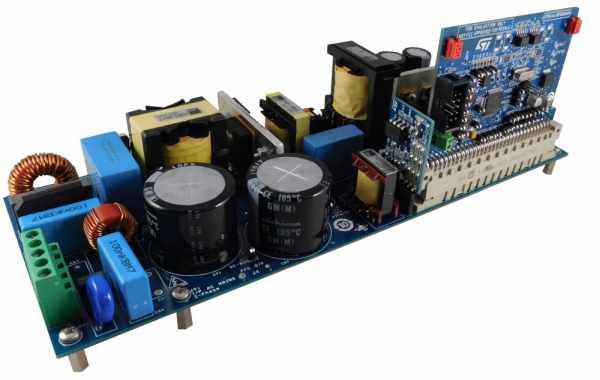
The STMicroelectronics STEVAL-LLL009V1 Digitally Controlled 300W Power Supply delivers high efficiency, power factor near unity, and low THD across wide input voltage and load conditions.
Features
- System architecture based on transition mode boost PFC, half bridge LCC and synchronous rectification (full bridge)
- 270V to 480VAC input voltage range
- Output can be configured in constant current (CC) or constant voltage (CV) mode:
- 300W maximum O/P power rating
- 48.5V ± 1% CV mode
- 6.25A ± 2.5% with voltage drop from 36 to 48V CC mode
- Peak efficiency >93.5%
- Power Factor > 0.9 for load > 33% of max. load of the input voltage range
- THD < 20% for load > 25% of max. load of the input voltage range
- Dimming control in CC mode configuration:
- 0V to 10V control
- 1% resolution
- Analog dimming
- Soft start
- I/P and O/P under and overvoltage protection, O/P open/no load circuit protection, O/P short/overload circuit protection
- Digitally controlled by STM32F334R8
- RoHS compliant
- WEEE compliant (2012/19/UE RAEE II)
Read more: STMICROELECTRONICS STEVAL-LLL009V1 DIGITALLY CONTROLLED POWER SUPPLY
- What components drive the PFC in this project?
The PFC is driven in transition mode by the L6562AT controller. - How is digital control implemented?
An STM32F334R8 microcontroller implements DC-DC and output synchronous rectification digital control. - Can the output be configured for constant current or voltage?
Yes, the output can be configured in constant current (CC) or constant voltage (CV) mode. - What is the peak efficiency of the system?
The peak efficiency is greater than 93.5%. - Which MOSFETs are used to reduce conduction losses on the secondary side?
The STripFET F7 Power MOSFET is employed to reduce conduction losses in the secondary side's synchronous rectification stage. - Does the power supply support dimming control?
Yes, it supports analog dimming in CC mode configuration with 0V to 10V control and 1% resolution. - What protection features are included?
It includes I/P and O/P under and overvoltage protection, O/P open/no load circuit protection, and O/P short/overload circuit protection. - What is the input voltage range supported?
The system supports an input voltage range of 270V to 480VAC.
