
Summary of 230V FAN REGULATOR CIRCUIT MOSFET MC33152 ATTINY25
This article details a 230V fan speed regulator project using an ATtiny25 microcontroller. It replaces traditional triacs with a P4NK60 MOSFET and MC33152 driver to handle inductive loads reliably. The system controls motor speed by switching power on for several AC periods and off for others, utilizing fan inertia to prevent jerky motion while maintaining smooth rotation.
Parts used in the 230V Fan Regulator:
- ATtiny25 microcontroller
- P4NK60 MOSFET transistor
- MC33152 special driver
- Transformer
- LED indicator
- IC3 stabilizer
- Diode D5
- Resistor R5
- Resistor R4
Brushless asynchronous motors, with compact rotor windings, called short cages, are used to drive different fans. Their advantages are durability and simple construction. The presented layout uses a certain characteristic of such a fan… Electronics Projects, 230V Fan Regulator Circuit Mosfet MC33152 ATtiny25 “avr project, microcontroller projects, power electronic projects, “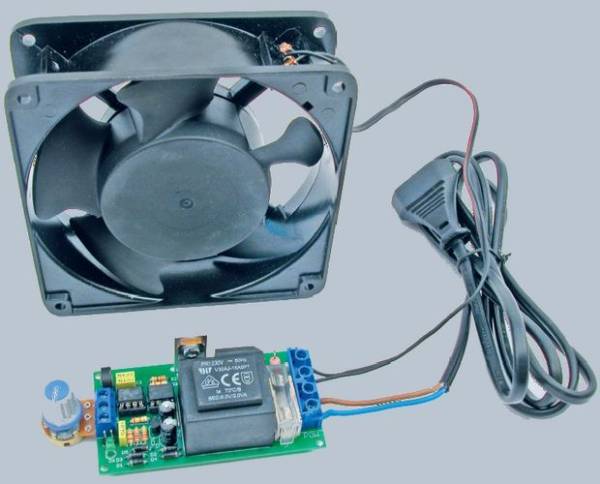
Brushless asynchronous motors, with compact rotor windings, called short cages, are used to drive different fans. Their advantages are durability and simple construction. The presented layout uses a certain characteristic of such a fan to regulate its rotational speed.
The operation is based on a group control method – the motor is powered by a sinusoidal 230V AC for several full periods, and then the power is cut off for several more periods.
Turn on and off times range from a fraction of a second to a few seconds, and thanks to the inertia of the fan, there is no stopping and starting effect of the engine, only the effect of light “swing” rotation.
Switching time is constant while changing the pause time between successive starts is controlled by the output power supplied to the receiver and, consequently, the engine speed.
230V FAN REGULATOR SCHEMATIC
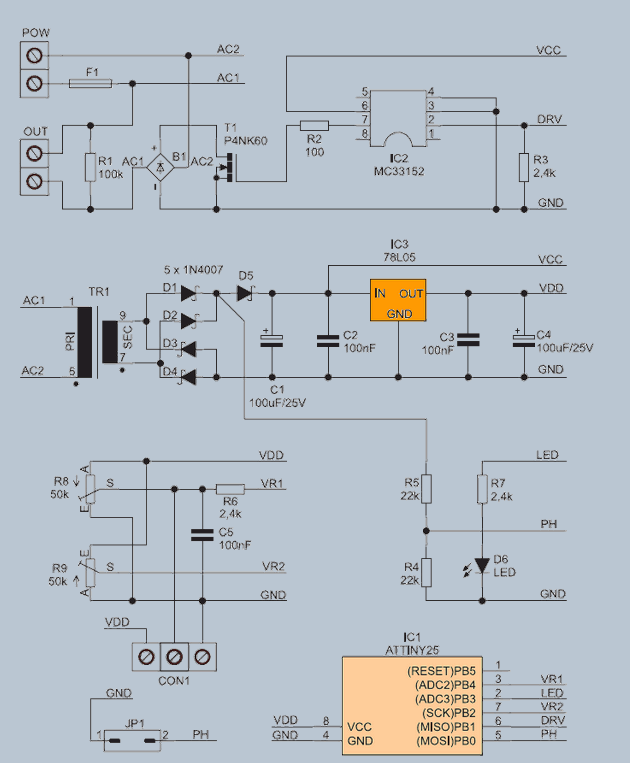
The ATtiny25 fan regulator’s schematic diagram is shown in Figure 2. The triacs “do not like” the inductive loads, so the rarely used circuit with the rectifier bridge and the P4NK60 MOSFET transistor are used instead of the triac actuator. This solution is more reliable in this application. The MC33152 special driver is correct for switching the transistor
The transformer, the LED and the IC3 stabilizer provide +5 V to power the ATtiny25 microcontroller. The diode signals the operation of the system – the flashing frequency is proportional to the set power, and the diode D5 and the resistors R5 and R4 form a zero-voltage detection system.
Source: 230V FAN REGULATOR CIRCUIT MOSFET MC33152 ATTINY25
- How does the fan regulator control rotational speed?
The motor is powered by sinusoidal 230V AC for several full periods and then cut off for several more periods. - Why are MOSFETs used instead of triacs in this circuit?
Triacs do not like inductive loads, so a rectifier bridge and P4NK60 MOSFET provide a more reliable solution. - What component provides the +5 V power supply for the microcontroller?
The transformer, LED, and IC3 stabilizer work together to provide +5 V to the ATtiny25. - Does the fan stop and start when the power cycles?
No, the inertia of the fan prevents stopping and starting, resulting only in a light swing rotation effect. - What indicates the operation status of the system visually?
An LED signals operation, with its flashing frequency being proportional to the set power level. - Which components form the zero-voltage detection system?
Diode D5 along with resistors R5 and R4 form the zero-voltage detection system. - Can the switching time be changed during operation?
The switching time remains constant while the pause time between starts is controlled to adjust engine speed.
