
Summary of RUEF300 – A FUSE WHICH NEVER BLOWS
### Summary LittelFuse's RUEF series offers resettable fuses using PTC technology, ideal for protecting components from transient shorts caused by user error. Unlike traditional fuses that require replacement, these parts automatically restore current flow after cooling down. However, they feature slower switching speeds (up to 10 seconds) and variable tripping points influenced by ambient temperature changes.
Parts used in the RUEF Series Project:
- RUEF series resettable fuses
- RUEF300 specific fuse model
- PTC (Positive Temperature Coefficient) component
- Load circuit
- USB port hub
Surface-mount fuses do a good job at protecting components from burning up – sadly, exchanging them is not a simple task manageable by end users. LittelFuse‘s RUEF series provide an attractive alternative, which is not widely known.
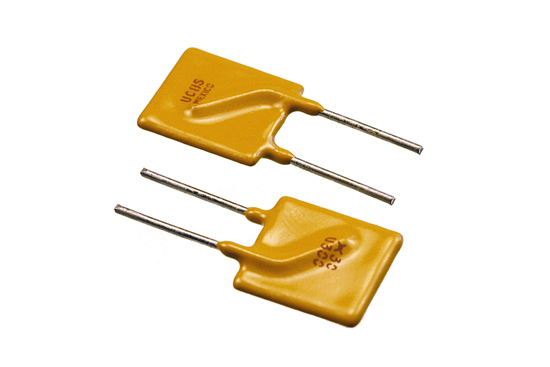
Parts like the RUEF300 are based on the concept of the PTC. Designers switch them in series with the load, meaning that the parts normally have a pretty low resistance (less than 1 Ohm). Current flows through them, their substrate temperature increases by the well-known thermal effect.
While the normal PTC changes its value linearly or exponentially, the resettable fuse jumps when reaching a specific temperature. At this point, the resistance increases dramatically, thereby dissipating most – but not all (!!!) – current through the load. When the overload situation ceases, the substrate cools off and restores normal current flow.
This makes PTC resettable fuses ideally suited for all cases where stupidity can cause transient shorts. A classic example would be a USB port – users tend to plug in things which they should not. Protecting the hub with a PTC is the best course of action: once the offending peripheral is removed, normal operation resumes without customer service action.
Beware of the consequences
The large thermal capacitance of the part leads to a relatively slow switching process – while a normal fuse can switch out in less than a second, the part on hand can take up to 10 seconds in a worst-case scenario. Our figure shows the problem: as the ambient temperature changes, the jump point changes too – in some cases, the tripping current can half itself.
Read more: RUEF300 – A FUSE WHICH NEVER BLOWS
- What is the main advantage of LittelFuse's RUEF series over standard fuses?
The RUEF series provides a resettable alternative that restores normal current flow without needing replacement after an overload. - How does a PTC resettable fuse operate during an overload?
The resistance increases dramatically at a specific temperature to dissipate most current, then drops back to normal once the substrate cools off. - Can end users easily replace traditional surface-mount fuses?
No, exchanging standard surface-mount fuses is not a simple task manageable by end users. - Why are resettable fuses suitable for USB ports?
They protect against transient shorts caused by users plugging in incorrect peripherals, allowing operation to resume automatically once the device is removed. - How long can the switching process take for a PTC resettable fuse?
The process can take up to 10 seconds in a worst-case scenario due to large thermal capacitance. - Does ambient temperature affect the performance of these fuses?
Yes, changing ambient temperatures alter the jump point, potentially causing the tripping current to half itself. - What is the typical resistance of these parts when functioning normally?
Designers switch them in series with the load where they normally have a low resistance of less than 1 Ohm.
