
Summary of AJIT – FIRST-EVER “MADE IN INDIA” MICROPROCESSOR DESIGNED BY IIT BOMBAY
This article highlights the development of AJIT, India's first indigenous SPARC ISA-based microprocessor by IIT Bombay under Prof. Madhav Desai. Part of the "Make In India" initiative, this 32-bit chip operates at 70-120 MHz using 180nm technology and includes an ALU, memory management unit, floating point unit, and hardware debugger. The team plans future upgrades to 400-500 MHz and a 65nm process, releasing their AHIR-V2 tool on GitHub.
Parts used in the AJIT Microprocessor:
- Arithmetic Logic Unit (ALU)
- Memory Management Unit
- Floating Point Unit (FPU)
- Hardware Debugger Unit
- Register Array
- Control Unit
In this modern era, the electronics industry is incomplete without microprocessors. From daily household appliances to space exploration – microprocessors are accompanying us everywhere and making lives way easier. But, independently designing and manufacturing a processor is an extremely complicated task and done by only a few countries like the US, Italy, France, Japan, Taiwan, Singapore, Malaysia, etc. India was not in the list, that’s until recently IIT Bombay, one of India’s premier technology institute developed the country’s first-ever indigenously-built SPARC ISA architecture based microprocessor called AJIT, led by Prof. Madhav Desai.
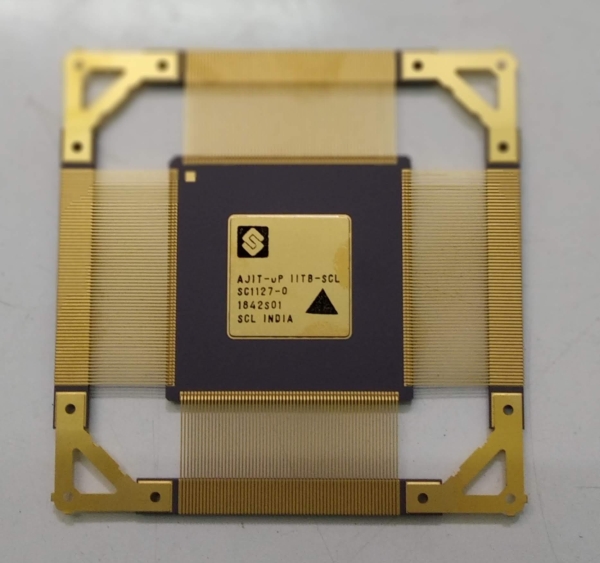
Here’s a quick introduction of microprocessor: A microprocessor is an IC comprises of millions or more transistors and function as the controlling unit of a micro-computer, fabricated on a small chip capable of performing ALU (Arithmetic Logical Unit) operations and communicating with the other devices connected to it. Microprocessor consists of an ALU, register array, and a control unit.
This project by IIT Bombay comes under the Government of India’s “Make In India” initiative which encourages both multinational and domestic companies to design and manufacture products within the country to make India a global manufacturing hub. The name “AJIT” is not an acronym and is derived from Sanskrit, meaning “Someone who has not been conquered“. As far as I could gather information, the AJIT microprocessor uses SPARCISA architecture. SPARC (Scalable Processor Architecture) is a reduced instruction set computing (RISC) instruction set architecture (ISA) originally developed by Sun Microsystems.
This 32-bit microprocessor is clocked at around 70-120 MHz, features an arithmetic logic unit (ALU), a memory management unit, a floating point unit (FPU) for high-speed floating point operations, and also a hardware debugger unit. As per the researchers associated with development, a clock speed of 400-500MHz is obtainable in the next upgrade. AJIT is a 180nm technology-based chip, but the researchers plan to move to a 65nm process eventually. They published the tool AHIR-V2 which used in this project on GitHub.
Read more: AJIT – FIRST-EVER “MADE IN INDIA” MICROPROCESSOR DESIGNED BY IIT BOMBAY
- Who developed the AJIT microprocessor?
IIT Bombay led by Prof. Madhav Desai. - What architecture does the AJIT microprocessor use?
It uses the SPARC ISA architecture. - What is the current clock speed of the AJIT chip?
The chip is clocked at around 70-120 MHz. - Which manufacturing technology node was used for AJIT?
AJIT is a 180nm technology-based chip. - What is the planned upgrade target for clock speed?
Researchers aim for a clock speed of 400-500MHz in the next upgrade. - Does the project include any software tools released publicly?
Yes, the team published the AHIR-V2 tool on GitHub. - What is the meaning of the name AJIT?
The name means Someone who has not been conquered in Sanskrit. - Under which government initiative was this project launched?
The project falls under the Make In India initiative.
