
Summary of AVR DAC using TLC5615 with ATmega16 using Proteus Simulation
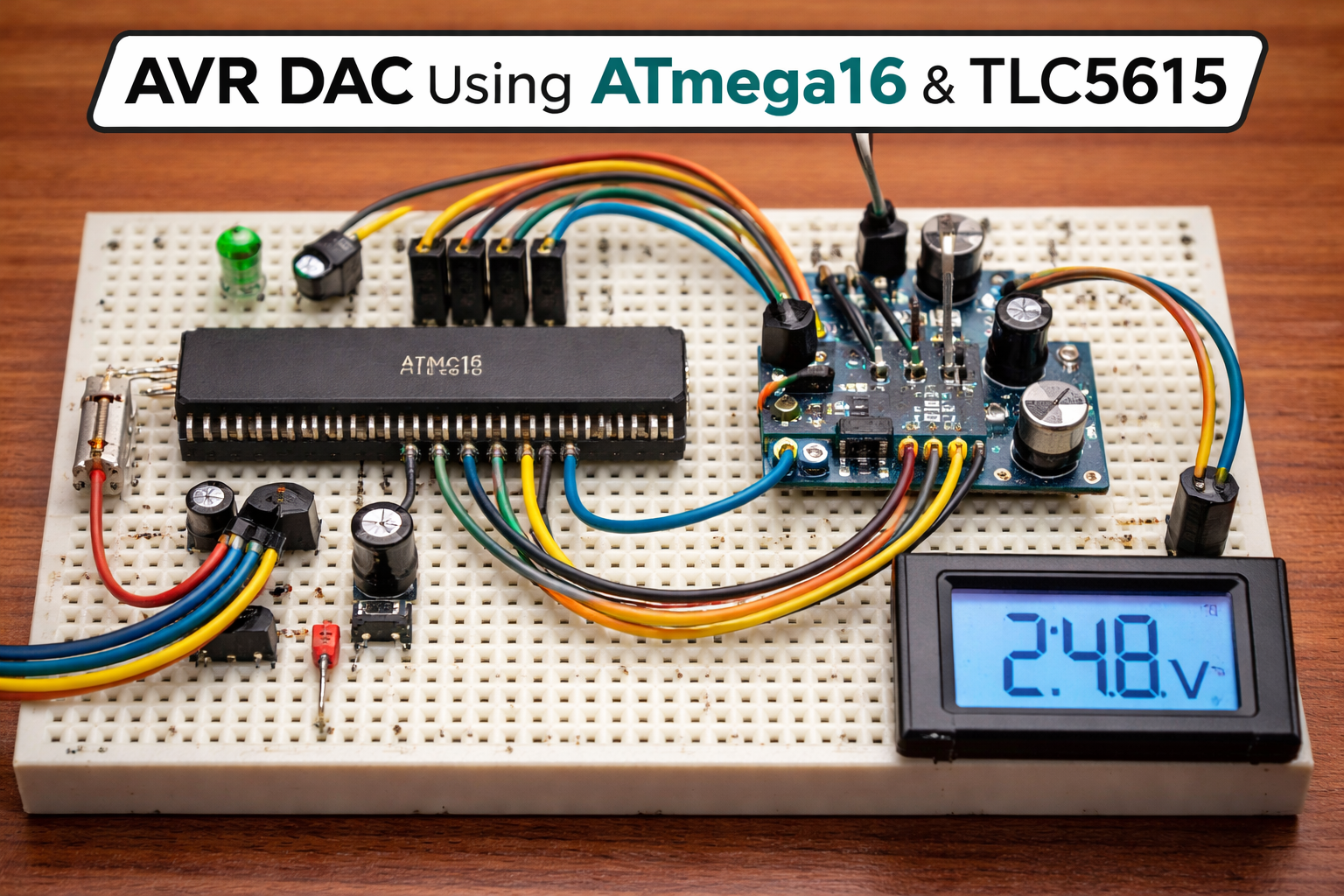
This project demonstrates generating analog output from a digital system by interfacing a TLC5615 DAC with an ATmega16 microcontroller using SPI communication in Proteus. The microcontroller sends 12-bit digital data to the DAC, which converts it into a corresponding analog voltage controlled by a reference voltage. This simulation is ideal for learning embedded systems design and firmware development without physical hardware.
Parts used in the AVR DAC Project:
- ATmega16 Microcontroller
- TLC5615 DAC
- Crystal Oscillator (8MHz)
- Capacitors (22pF, 100nF)
- Resistors (1k, 220Ω, 10k)
- Diodes (1N4148)
- Potentiometer (1k)
- Push Button (Reset)
- Voltmeter
- Power Supply (VCC)
Introduction
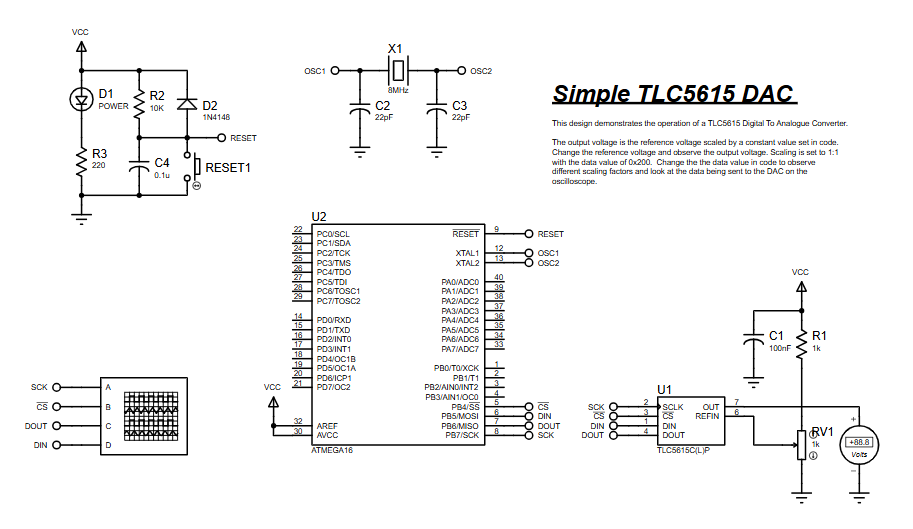
This project demonstrates an AVR DAC using TLC5615 ATmega16, where a microcontroller generates analog output using SPI communication. It is a simple and practical example of a microcontroller project implemented in Proteus simulation.
The system converts digital values into analog voltage, making it useful for learning embedded systems and practical electronics. Such designs are widely used in signal generation, control systems, and real-world applications where digital-to-analog conversion is required.
How the Project Works (Overview)
The ATmega16 microcontroller communicates with the TLC5615 DAC using the SPI protocol. A fixed digital value is sent repeatedly from the MCU to the DAC.
- The DAC receives 12-bit data
- Converts it into an analog voltage
- Outputs the voltage through its output pin
In this project, the value 0x200 is used, which corresponds to Vref output level, meaning the output voltage equals the reference voltage applied to the DAC.
Workflow Explanation
The system works in a simple data flow:
- ATmega16 (Master Controller)
- Generates digital data
- Sends via SPI
- SPI Communication Lines
- SCK (Clock)
- DIN (Data input)
- CS (Chip Select)
- TLC5615 DAC
- Receives 12-bit digital data
- Converts to analog voltage
- Output Section
- Analog voltage measured via voltmeter
- Reference voltage controlled using potentiometer
The reset circuit and crystal oscillator ensure stable operation of the microcontroller.
Key Features
- SPI-based communication between MCU and DAC
- 12-bit digital-to-analog conversion
- Stable analog output based on reference voltage
- Simple firmware with continuous data transmission
- Proteus simulation ready design
- Adjustable output via reference voltage (RV1)
- Clean embedded systems implementation using AVR
Components Used
- ATmega16 Microcontroller (AVR)
- TLC5615 DAC
- Crystal Oscillator (8MHz)
- Capacitors (22pF, 100nF)
- Resistors (1k, 220Ω, 10k)
- Diodes (1N4148)
- Potentiometer (1k)
- Push Button (Reset)
- Voltmeter (for output visualization)
- Power Supply (VCC)
Applications
- Analog signal generation systems
- Audio signal output (basic DAC applications)
- Sensor calibration systems
- Embedded control systems requiring analog output
- Educational DIY electronics and embedded systems learning
- Signal processing experiments
Explanation of Code
The firmware initializes the ATmega16 and sets up SPI communication in Master mode.
- SPI Initialization
- Configured using
SPCR = 0x53 - Sets MCU as SPI master with clock frequency division
- Configured using
- Data Preparation
- Initial value
0x200is shifted to align with 12-bit DAC format - Masked to ensure valid data range
- Initial value
- Data Transmission
- Chip Select (CS) is activated
- High byte and low byte are sent sequentially via SPI
- DAC updates its output after receiving data
- Continuous Loop
- The same value is repeatedly sent
- A delay ensures stable output observation
This demonstrates a simple but effective DAC interfacing using SPI in embedded systems.
Source Code
/********************************
FILE NAME:        main.c
CHIP TYPE:        ATMEGA16
CLOCK FREQUENCY:  8MHZ
IDE:              VSMStudio
COMPILER:         AVR-GCC
TIME:             September 2010
********************************/
#include <avr/io.h>
#define uchar unsigned char
#define uint unsigned int

// Low level port/pin definitions
#define sbit(x,PORT) (PORT) |= (1<<x)
#define cbit(x,PORT) (PORT) &= ~(1<<x)
#define pin(x,PIN) (PIN)&(1<<x)Proteus Simulation
The Proteus simulation demonstrates the complete working of the system:
- ATmega16 sends digital data via SPI
- TLC5615 converts it into analog voltage
- Output is visible on a voltmeter
- Changing the reference voltage (RV1) affects output proportionally
The simulation clearly shows how digital values map to analog voltages, making it ideal for learning DAC behavior.
Conclusion
This project is a solid introduction to DAC interfacing in embedded systems using AVR microcontrollers. It demonstrates how digital data can be converted into analog signals using SPI communication.
With a simple setup and clear Proteus simulation, this project is ideal for beginners exploring microcontroller projects, firmware development, and practical electronics design.
Complete File
AVR DAC using TLC5615 with ATmega16 using Proteus Simulation
- How does the ATmega16 communicate with the TLC5615?
The microcontroller communicates with the DAC using the SPI protocol. - What type of data conversion does this project perform?
The project converts 12-bit digital data into an analog voltage. - Which value is used in the code to match the reference voltage level?
The value 0x200 is used, which corresponds to the Vref output level. - Does changing the reference voltage affect the output?
Yes, changing the reference voltage via potentiometer RV1 affects the output proportionally. - What is the clock frequency configured for the ATmega16?
The system uses an 8MHz crystal oscillator for the clock frequency. - How are the high and low bytes transmitted to the DAC?
The high byte and low byte are sent sequentially via SPI after activating Chip Select. - Can this project be simulated without physical hardware?
Yes, the entire system is designed for Proteus simulation to understand practical electronics. - What is the purpose of the reset circuit and crystal oscillator?
They ensure stable operation of the microcontroller.
