
Summary of AVR External Memory Access using ATmega8515 with Proteus Simulation
This project demonstrates ATmega8515 external memory interfacing in Proteus: the MCU writes 0x55 and 0xAA to SRAM addresses 0x0400–0x0401 using a multiplexed low address/data bus latched by a 74LS373, then reads the data back and shows timing in a digital analysis window. It toggles MCUCR for two wait-state settings and ends in sleep mode, offering a compact educational example of AVR memory-mapped access and bus timing visualization.
Parts used in the ATmega8515 External Memory Access Project:
- ATmega8515 AVR microcontroller
- 74LS373 octal latch
- 6264 SRAM memory IC
- Clock reference / timing source (simulation)
- Proteus digital analysis graph/module (simulation)
- Interconnecting address, data, and control buses/wiring
Introduction
This microcontroller project demonstrates how an ATmega8515 communicates with external memory inside a Proteus simulation environment. The design focuses on memory access cycles, showing how the AVR handles external address and data lines when connected to SRAM. It is a useful example for anyone learning embedded systems, memory-mapped interfacing, and practical electronics. Instead of a complex end product, this project highlights an important low-level concept that appears in many real hardware designs. For students, hobbyists, and engineers working in DIY electronics, it is a clean way to understand the working principle of external memory expansion with AVR.
How the Project Works
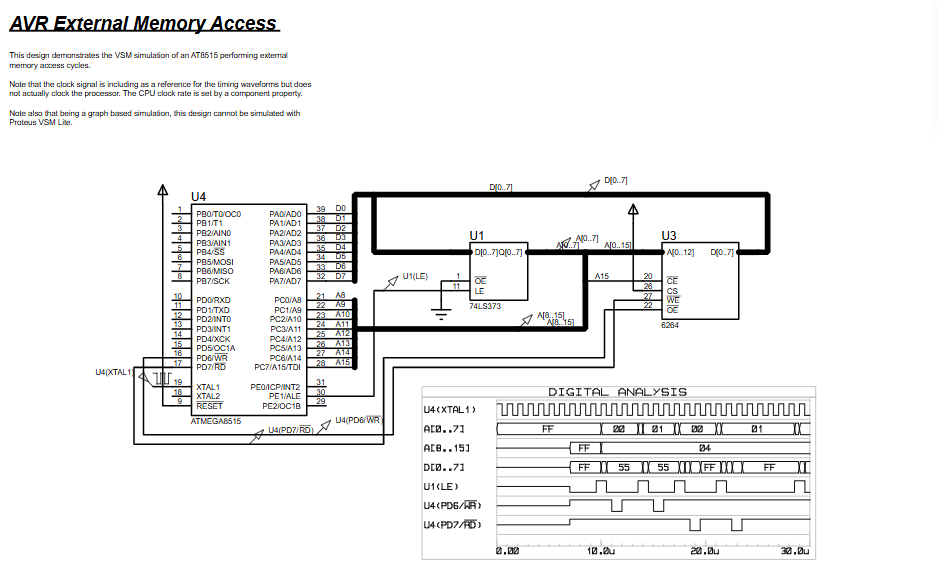
This project shows the ATmega8515 writing data to external memory and then reading it back. The AVR uses its external memory interface to communicate with a 6264 SRAM chip. Since the lower address lines and data lines are shared on the AVR, a 74LS373 latch is used to hold the lower address bits during the access cycle.
In the source code, the microcontroller enables external SRAM support by writing to the MCUCR register. It first performs memory operations with one setting, writes the value 0x55 to external addresses 0x0400 and 0x0401, and reads those locations back. Then it changes the configuration, writes 0xAA to the same addresses, and reads them again. After completing the access sequence, the controller enters sleep mode.
This makes the design a straightforward AVR external memory access sample and a useful Proteus simulation for studying bus timing and memory transactions.
Workflow Explanation
1. ATmega8515 Microcontroller
The ATmega8515 is the main controller in the circuit. It generates the external memory control and addressing signals.
2. Multiplexed Low Address/Data Bus
The low byte of the address and the data bus share the same lines. These lines are routed through the bus marked D[0..7] / AD[0..7].
3. Address Latch (74LS373)
The 74LS373 captures and holds the low address byte when the latch enable signal is active. This separates the address from the data during the memory access cycle.
4. High Address Bus
The higher address lines are sent directly from the AVR to the external SRAM through the A[8..15] path.
5. External SRAM (6264)
The 6264 SRAM receives the latched low address, the upper address lines, and the control signals. It stores the bytes written by the AVR and returns them during read operations.
6. Digital Analysis Window
The waveform area in the schematic shows how address, data, latch enable, and read/write activity behave over time. This helps visualize the memory access sequence during simulation.
Key Features
-
Demonstrates external memory access with an ATmega8515
-
Uses 6264 SRAM as external memory
-
Uses 74LS373 to latch the lower address byte
-
Shows both write and read operations
-
Accesses external memory locations
0x0400and0x0401 -
Tests memory using two data patterns:
0x55and0xAA -
Includes digital timing visualization in Proteus VSM
-
Useful for learning AVR memory interfacing and bus behavior
Components Used
Based on the schematic and source code, the project uses:
-
ATmega8515 AVR microcontroller
-
74LS373 octal latch
-
6264 SRAM memory IC
-
Clock reference / timing source shown in simulation
-
Proteus digital analysis graph
-
Interconnecting address, data, and control buses
Applications
This type of system is useful in:
-
Learning how AVR controllers interface with external memory
-
Understanding address/data bus multiplexing in embedded systems
-
Studying memory-mapped hardware design
-
Testing SRAM access timing in simulation
-
Academic labs for microcontroller project development
-
Prototyping firmware that may need external memory expansion
Working Principle
The working principle is based on external memory bus operation.
The ATmega8515 places the lower address byte on the multiplexed bus, and the 74LS373 latches that value when the latch enable signal is active. At the same time, the high address byte is sent separately. Once the address is stable, the AVR performs either a write or read cycle with the external 6264 SRAM.
In this design, the firmware writes known values into external memory and then reads them back. The waveform display in the Proteus simulation helps confirm that the address, data, and control signals are switching in the expected sequence.
Explanation of Code
The assembly code is small and focused on the memory interface test.
Stack Initialization
The program begins by initializing the stack pointer.
External Memory Configuration
The code writes different values to the MCUCR register:
-
0xA0enables sleep and external SRAM with 0 wait states -
0xE0enables sleep and external SRAM with 1 wait state
This allows the project to demonstrate two access timing settings.
Write Operations
The firmware writes:
-
0x55to address0x0400 -
0x55to address0x0401
Then later:
-
0xAAto address0x0400 -
0xAAto address0x0401
Read Operations
After each write sequence, the code reads back from the same addresses into register r0.
Sleep Mode
At the end of the routine, the controller enters sleep mode.
This makes the firmware a compact demonstration of source code for AVR external SRAM access rather than a full application program.
Source Code
; EEPROM - Read Write the EEPROM.
; Specify Device.
.device ATMEGA8515

; Variable Declarations
.def temp     = r16
.def isrsreg  = r17
.def isrtemp1 = r18
.def isrtemp2 = r19
.def isrflag  = r20

.cseg					; CODE segment.

.org 0
rjmp init ; origin.Proteus Simulation
This Proteus simulation demonstrates the VSM behavior of an ATmega8515 performing external memory access cycles. The schematic includes a digital analysis section so the address bus, data bus, latch enable signal, and memory control activity can be observed visually.
During simulation, the AVR writes data to external SRAM, reads the same locations back, and repeats the process with a different configuration. The waveform view helps verify the working principle, especially the separation of address and data using the latch.
The design note in the schematic also indicates that the clock signal is included as a timing reference for the waveforms, while the processor clock itself is set through a component property. It also notes that this graph-based design cannot be simulated with Proteus VSM Lite.
Conclusion
This project is a clean and practical example of external memory interfacing in AVR-based embedded systems. Instead of focusing on a final product, it teaches a core hardware concept through a simple Proteus simulation, a clear circuit diagram, and compact firmware. For anyone learning AVR architecture, bus timing, or memory expansion in DIY electronics, this is a very useful reference design.
Complete File
AVR External Memory Access using ATmega8515 with Proteus Simulation
- How does the ATmega8515 separate address and data on the multiplexed bus?
It uses a 74LS373 latch to capture and hold the lower address byte while the data lines are used for data transfer. - What external memory chip is used in the project?
The project uses a 6264 SRAM memory IC. - Which memory addresses are accessed by the firmware?
The firmware accesses external memory locations 0x0400 and 0x0401. - What data patterns are written to SRAM during the test?
The firmware writes 0x55 and later 0xAA to the test addresses. - How does the code change memory access timing?
The code writes different values to the MCUCR register to enable external SRAM with 0 or 1 wait state (0xA0 and 0xE0 respectively). - What visualization aids are included in the Proteus simulation?
The schematic includes a digital analysis window showing address, data, latch enable, and read/write activity waveforms. - Does the project demonstrate both write and read cycles?
Yes, the project demonstrates both write and read operations to external SRAM. - What happens after the memory access sequence completes?
After completing the access sequence, the controller enters sleep mode.
