
Summary of Temperature Meter using ATmega16 with Proteus Simulation
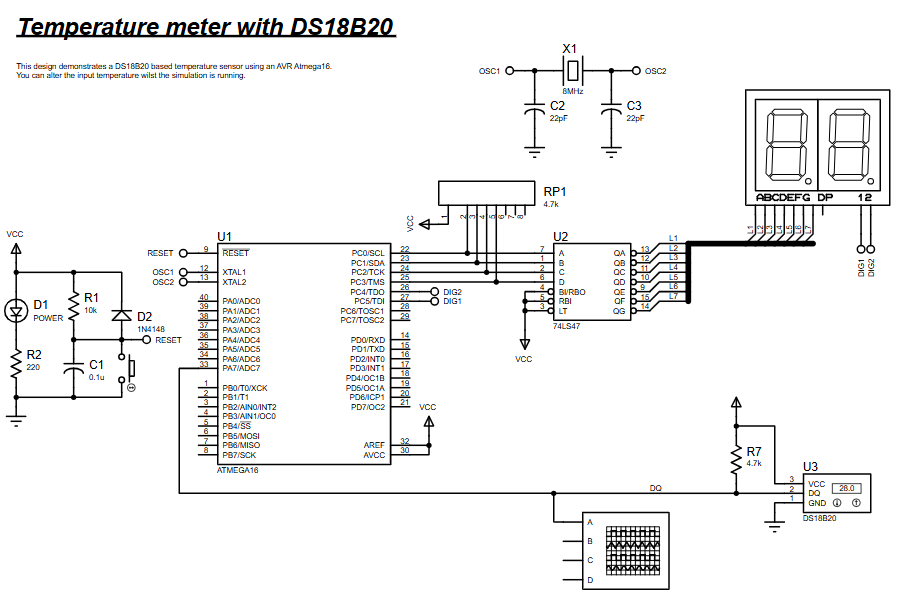
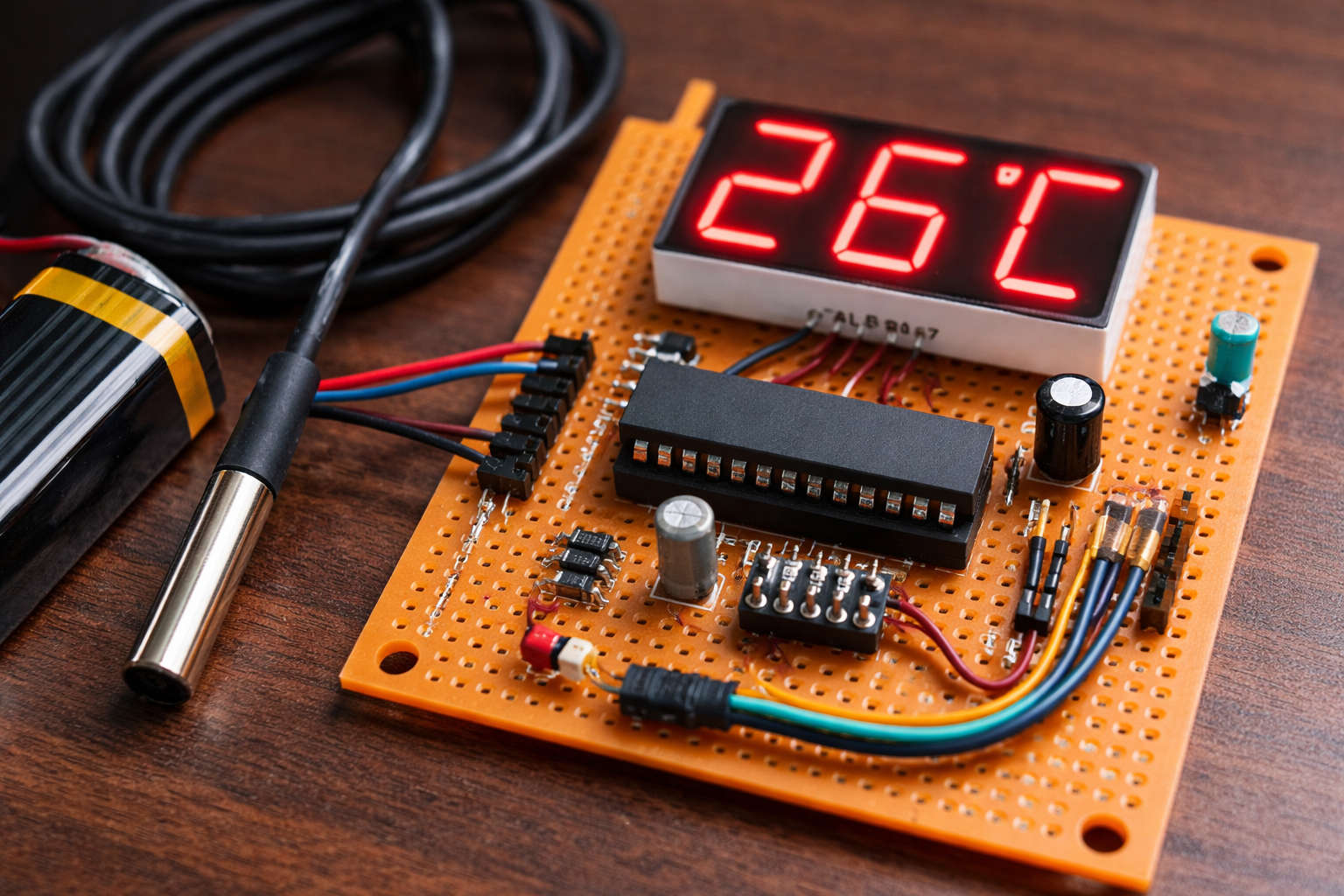
This project presents a digital temperature measurement system using an ATmega16 microcontroller and a DS18B20 sensor. Simulated in Proteus, the system reads real-time temperature data via 1-Wire protocol, processes it, and displays the value on a dual 7-segment display using a 74LS47 decoder and multiplexing. It serves as an educational tool for embedded systems, covering sensor interfacing, digital communication, and display control without requiring physical hardware.
Parts used in the Digital Temperature Measurement System:
- ATmega16 Microcontroller
- DS18B20 Temperature Sensor
- 74LS47 BCD to 7-Segment Decoder
- Dual 7-Segment Display
- Crystal Oscillator (8 MHz)
- Resistors (Pull-up and current limiting)
- Capacitors
- Power supply
Introduction
This microcontroller project demonstrates a digital temperature measurement system using the DS18B20 sensor and an ATmega16 microcontroller. The system reads temperature data and displays it on a dual 7-segment display in real time. Built and tested in a Proteus simulation environment, this project is a great example of embedded systems and practical electronics. It highlights how digital sensors can be interfaced with AVR microcontrollers for accurate measurements. This type of DIY electronics project is widely used in automation, monitoring systems, and learning applications.
How the Project Works (Overview)
The DS18B20 temperature sensor communicates with the ATmega16 using a 1-Wire protocol. The microcontroller sends commands to initiate temperature conversion and then reads the digital temperature data.
The measured value is processed and split into tens and units digits. These digits are then multiplexed and displayed on a 7-segment display using a BCD to 7-segment decoder (74LS47). The system continuously reads and updates the temperature in real time.
Workflow Explanation
- Temperature Sensing
The DS18B20 sensor measures temperature and converts it into digital data. - Microcontroller Processing
The ATmega16:- Sends commands to the sensor
- Reads temperature data
- Converts it into displayable format
- Display Control
- Data is sent to the 74LS47 decoder
- Multiplexing is used to drive two 7-segment digits
- Output Display
The temperature value is displayed in decimal form.
Key Features
- Digital temperature sensing using DS18B20
- High accuracy measurement with 1-Wire communication
- Real-time display on dual 7-segment display
- Multiplexing technique for efficient display control
- AVR ATmega16 based embedded system design
- Fully simulated in Proteus (no hardware required)
Components Used
- ATmega16 Microcontroller
- DS18B20 Temperature Sensor
- 74LS47 BCD to 7-Segment Decoder
- Dual 7-Segment Display
- Crystal Oscillator (8 MHz)
- Resistors (Pull-up and current limiting)
- Capacitors
- Power supply
Applications
- Room temperature monitoring systems
- Industrial temperature sensing
- HVAC control systems
- Embedded systems learning projects
- Digital thermometers
- IoT-based environmental monitoring (extendable)
Explanation of Code
The firmware is written in AVR-GCC and handles sensor communication, data processing, and display control.
Key Functional Modules:
- 1-Wire Communication
Functions likeinit_ds18b20(),writecommand(), andreadbyte()manage communication with the DS18B20 sensor. - Temperature Reading
Thereadtemp()function:- Initiates temperature conversion
- Reads scratchpad data
- Converts raw data into Celsius
- Display Logic
The main loop splits the temperature into digits and uses multiplexing to drive the 7-segment display. - Timing Control
_delay_ms()and_delay_us()ensure proper communication timing and display refresh.
Source Code
/********************************
FILE NAME:        DS18B20.c
CHIP TYPE:        ATMEGA16
CLOCK FREQUENCY:  8MHZ
IDE:              VSMStudio
COMPILER:         AVR-GCC
TIME:             September 2010
********************************/

#include <avr/io.h>
#include <util/delay.h>

#define uchar unsigned char
#define uint unsigned int
#define BUS PORTCProteus Simulation
The Proteus simulation demonstrates real-time temperature variation using the DS18B20 sensor model. As the temperature input changes, the 7-segment display updates instantly. The simulation accurately reflects embedded system behavior, including sensor communication and display multiplexing.
Conclusion
This project is a solid introduction to temperature sensing using embedded systems. It combines sensor interfacing, digital communication, and display control in a practical Proteus simulation setup. Whether you’re learning microcontroller programming or exploring DIY electronics, this project provides a strong foundation for real-world applications.
Complete File
Temperature Meter using ATmega16 with Proteus Simulation
- How does the DS18B20 communicate with the microcontroller?
The DS18B20 communicates with the ATmega16 using a 1-Wire protocol. - What is the role of the 74LS47 decoder in this project?
The 74LS47 acts as a BCD to 7-segment decoder to drive the display digits. - Can this project be built without physical hardware?
Yes, the entire system is fully simulated in Proteus, so no hardware is required. - Which compiler was used to write the firmware?
The firmware is written using AVR-GCC. - What frequency is used for the crystal oscillator?
An 8 MHz crystal oscillator is used for the clock frequency. - Does the system update the temperature in real time?
Yes, the system continuously reads and updates the temperature in real time. - How are the tens and units digits displayed?
The digits are split, multiplexed, and driven by the 7-segment display. - What function initiates the temperature conversion?
The readtemp function initiates the temperature conversion process. - Are delay functions used for timing control?
Yes, _delay_ms and _delay_us ensure proper communication timing and display refresh. - What type of display output is shown?
The temperature value is displayed in decimal form on a dual 7-segment display.
