
Summary of Atmega8 measures ambient temperature and relative humidity using HSM-20G sensor
This article details a project by Shawon Shahryiar to measure ambient temperature and relative humidity using an HSM-20G analog sensor interfaced with an Atmega8 microcontroller. Unlike digital sensors, this module outputs standard voltages. The author utilized MATLAB's polyfit function to derive third-degree equations for converting voltage readings into accurate environmental data, leveraging the AVR's hardware multiplier for efficient calculation within the MikroC environment.
Parts used in the Atmega8 measures ambient temperature and relative humidity using HSM-20G sensor:
- ATMega8A micro
- HSM-20G analog relative humidity and temperature sensor module
- 28 pin AVR development board
- Passive components
In one of my previous posts, I discussed about Sensirion’s SHT11 and SHT75 sensors, which are capable of measuring both temperature and relative humidity. They are digital sensors and provide fully calibrated digital outputs for temperature and relative humidity. I also illustrated how to interface those sensors with a PIC microcontroller. Shawon Shahryiar from Dhaka, Bangladesh shared this project with us where he describes a method of interfacing the HSM-20G sensor to Atmega8 for measuring the ambient temperature and relative humidity. Unlike Sensirion’s SHT series, this is an analog sensor that converts the two ambient parameters into standard output voltages.
Shawon writes,
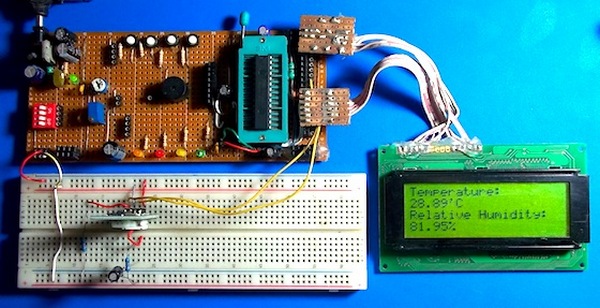
The materials used for the project are a ATMega8A micro. A HSM-20G analog relative humidity and temperature sensor module and my own-made 28 pin AVR development board along with some passive components. MikroC for AVR 5.00 compiler was used for coding.
Link for HSM-20G datasheet:
http://www.justmystage.com/home/bellseki/HSM-20G.pdf.
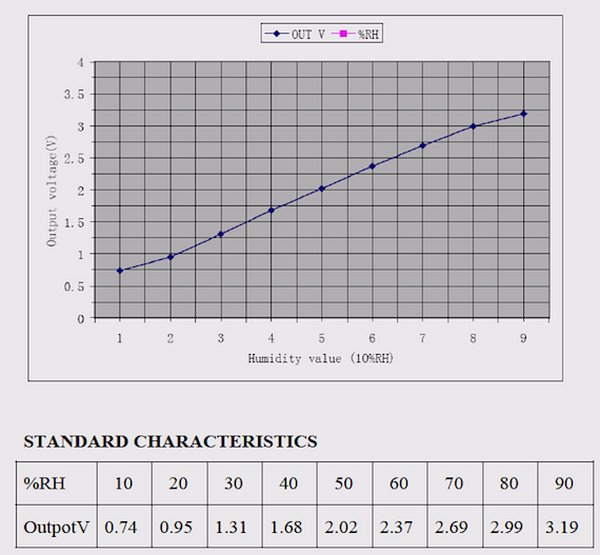
HSM-20G is an analog sensor module unlike SHT75 or SHT21. If you go through the datasheet of HSM-20G, you will find out that they have given output voltage data from the humidity sensor for certain relative humidity values and they have plotted a graph too. What I did is simply used those data to plot and check if their graph is valid or fake. Now as you may notice the plot is not linear but rather has curve-like nature. Thus I used MATLAB’s “polyfit” function to get a equation for the plotted curve to the third degree.
The reasons for using a third degree equation are firstly AVR has a built-in hardware multiplier that works pretty fast. Secondly I won’t be using the micro to do any other tasks rather than metering. This is enough for a fairly good precision. A second degree is not that good enough while a higher order equation is unnecessary. If you you go through my program, you will see the equation under the function “read_humidity()”. The micro computes the data it gets from the HSM-20G module for relative humidity and determines what it should show.
The same task I did for temperature measurement but finding its data was a little cumbersome. If you see the datasheet for the module, you will notice they have given a circuit for interfacing the module to other peripherals like a micro or a multimeter and I used that circuit. However since they don’t know what value of resistance the user will use at the temperature circuit side and because it’s a thermistor built inside rather than semiconductor type sensor, they have provided resistance values rather than output voltages at various temperatures. Therefore and since I used their circuit, I calculated the voltages at different temperatures from their data. Again I used the voltage and temperature data as I did for the relative humidity part.
For more Detail: Atmega8 measures ambient temperature and relative humidity using HSM-20G sensor
- What type of sensor is the HSM-20G?
The HSM-20G is an analog sensor module that converts ambient parameters into standard output voltages. - How was the equation for the humidity curve determined?
MATLAB's polyfit function was used to plot the curve and generate a third-degree equation. - Why was a third-degree equation chosen over other degrees?
A third-degree equation balances precision with the speed of the AVR's built-in hardware multiplier without unnecessary complexity. - Which compiler was used for coding the project?
MikroC for AVR 5.00 compiler was used for coding. - How were temperature values calculated given the datasheet provided resistance data?
Voltages at different temperatures were calculated from the provided resistance data since the module uses a thermistor. - Does the HSM-20G provide fully calibrated digital outputs like Sensirion sensors?
No, unlike Sensirion's SHT series, the HSM-20G provides analog output voltages rather than digital outputs. - Where is the humidity calculation equation located in the program?
The equation is located under the function read_humidity(). - What specific component inside the HSM-20G module handles temperature sensing?
A thermistor built inside the module is used for temperature sensing.
