
Summary of How a Theremin Works
In the early 1920s, Léon Theremin invented an electronic musical instrument using human body capacitance to disrupt electromagnetic fields. The device operates via two primary circuits: a pitch circuit and a volume circuit. The pitch circuit mixes signals from fixed and variable radio frequency oscillators through heterodyning to produce audible tones. The volume circuit utilizes a separate oscillator and antenna to control sound levels when the player's hand approaches.
Parts used in the Theremin:
- Pitch circuit
- Volume circuit
- Fixed oscillator
- Variable oscillator
- Vertical antenna
- Amplifier
How it Works: The Science Behind the Magic
Way back in the early 1920s, when Léon Theremin worked at the Physico-Technical Institute in St. Petersburg, Russia, he noticed that when he moved his body in or out of an electromagnetic field produced by a radio frequency oscillating circuit, he changed its frequency [source: Harrison]. The human body has a certain natural capacitance (the ability to hold an electrical charge). What Theremin observed when he used his body to disrupt the oscillator’s electromagnetic field was the effect of this capacitance. Maybe because he was a musician and a cellist by hobby, Theremin began pondering how to exploit capacitance to create a new musical instrument.
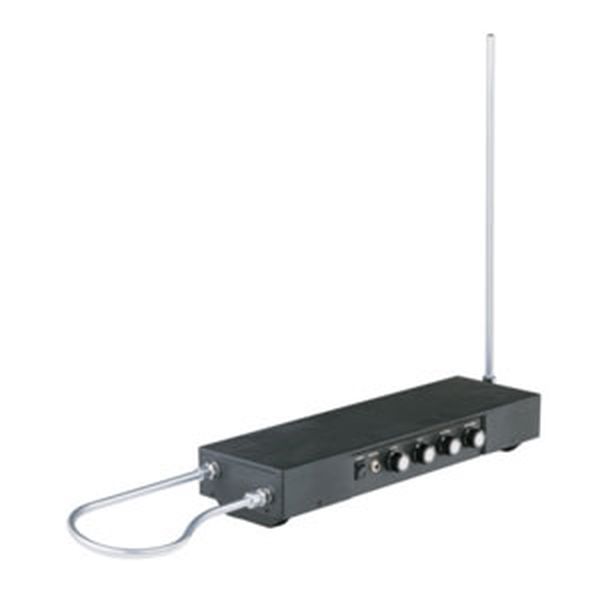
In a 1989 interview with Olivia Mattis, Theremin said, “I conceived of an instrument that would create sound without using any mechanical energy, like the conductor of an orchestra” [source: Mattis]. What Theremin dreamed up was an electronic instrument with two primary circuits: a pitch circuit and a volume circuit. The pitch circuit used two tuned (radio frequency) oscillators: a fixed oscillator and a variable oscillator. The fixed oscillator generated waves at a static frequency. The variable oscillator was capable of producing a range of frequencies and was connected to a vertical antenna. Through a process called heterodyning, signals from the fixed and variable oscillators were mixed together. The frequency of one oscillator was subtracted from the other. The difference was amplified and, finally, output as an audible musical tone.
The second circuit (the volume circuit) controlled the level of the tone generated by the pitch circuit. Much like in the pitch circuit, it used an oscillator connected to an antenna. Disrupting the electromagnetic field around this antenna raises or lowered the volume of the music tone generated by the pitch circuit.
For more detail: How a Theremin Works
- How did Léon Theremin discover the principle behind his instrument?
He noticed that moving his body in or out of an electromagnetic field changed its frequency due to natural body capacitance. - What are the two primary circuits in a Theremin?
The instrument uses a pitch circuit and a volume circuit. - How does the pitch circuit generate sound?
It mixes signals from fixed and variable oscillators through heterodyning to create an audible tone. - What is the function of the vertical antenna?
The vertical antenna is connected to the variable oscillator to allow the player to control pitch by disrupting the electromagnetic field. - How does the volume circuit work?
An oscillator connected to an antenna controls the tone level; disrupting the field raises or lowers the volume. - Does the Theremin use mechanical energy to create sound?
No, it creates sound without using any mechanical energy like a conductor of an orchestra. - What happens after the signals from the oscillators are mixed?
The difference in frequency is amplified and output as an audible musical tone. - Why did Theremin begin pondering this invention?
He was a musician and cellist who wanted to exploit capacitance to create a new musical instrument.
