
Summary of Interfacing ATmega32 with an LCD and a DAC
This project interfaces an ATmega32 microcontroller with an LCD and a DAC, includes two push-buttons and an In-System Programming (ISP) connector, and runs on a 14.7456 MHz crystal suitable for generating standard baud rates used in RS422 communication. The ATmega32 provides UART, SPI, TWI, timers, and 32-bit I/O for versatile embedded control.
Parts used in the ATmega32 LCD DAC Interface Project:
- ATmega32 microcontroller
- LCD module
- Digital-to-Analog Converter (DAC)
- 14.7456 MHz crystal
- Two general purpose push-buttons
- In System Programming (ISP) connector
- Supporting passive components (resistors, capacitors)
- Power supply components (regulator, decoupling caps)
Hi techies!!
This is one more of my circuits, interfacing ATmega32 with an LCD and a DAC. it also includes two general purpose push-buttons and In System Programming connector. The controller is operating with 14.7456 MHz frequency crystal, convenient for generating standard baud rates (for RS422 communication whic i used in my actual project, not shown here).
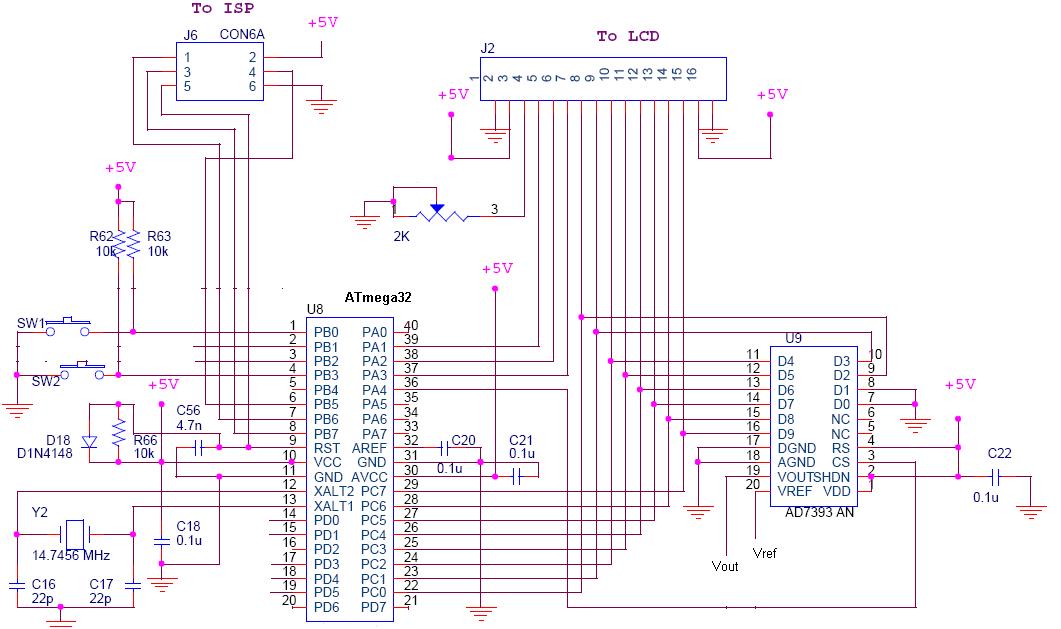
The Atmel AVR controller ATmega32 is a very powerful chip with 1 MIPS/MHz throughput and contains a lots of on-chip peripherals like UART, SPI, 32bits I/O, TWI(I2C compatible), versatile timer/counters and lot more.
For more detail: interfacing ATmega32
- What microcontroller is used in this project?
The ATmega32 microcontroller is used in this project. - What peripheral devices are interfaced to the ATmega32?
An LCD module and a DAC are interfaced to the ATmega32. - What is the operating crystal frequency of the controller?
The controller operates with a 14.7456 MHz crystal. - Why is the 14.7456 MHz crystal chosen?
It is convenient for generating standard baud rates for RS422 communication. - How many push-buttons are included?
The project includes two general purpose push-buttons. - Is there provision for in-circuit programming?
Yes, an In System Programming connector is included. - Which on-chip peripherals of ATmega32 are mentioned?
The ATmega32 provides UART, SPI, TWI, versatile timer/counters, and 32-bit I/O. - Is RS422 communication shown in the schematic?
RS422 communication was used in the actual project but is not shown here.
