
Summary of THERMOMETER HYGROMETER CIRCUIT USB DHT22 ATMEGA8
This article describes a compact USB thermometer and hygrometer project using a DHT22 sensor and an ATmega8 microcontroller. The device measures temperature (-40°C to 80°C) and humidity (0–100%) with high resolution, connecting directly to a computer via USB. It features surface-mount components for a small form factor suitable as a laptop adapter, with firmware developed in the Bascom AVR environment.
Parts used in Thermometer Hygrometer Circuit USB DHT22 ATmega8:
- DHT22 temperature and humidity sensor
- ATmega8 microcontroller
- FT232 chip
- 7.3728 MHz quartz resonator
- Jumper and serial components
- Surface mount elements
The presented layout is a snap on a computer for measuring DHT22 temperature and humidity. It measures the temperature from -40 to 80 ° C with a resolution of 0.1 ° C and accuracy… Electronics Projects,Thermometer Hygrometer Circuit USB DHT22 ATmega8 “atmega8 projects, avr project, microcontroller projects, “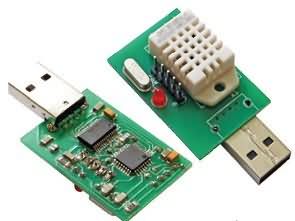
The presented layout is a snap on a computer for measuring DHT22 temperature and humidity. It measures the temperature from -40 to 80 ° C with a resolution of 0.1 ° C and accuracy of 0.2 ° C and humidity from 0 to 100% with a resolution of 0.1% and accuracy of 2%. The device was designed on a tiny size plate with the advantage of surface mount elements, so it can be used as a laptop or desktop adapter. The microcontroller control program was written in the Bascom AVR environment. The DHT22 sensortemperature and humidity reading
DHT22 THERMOMETER HYGROMETER CIRCUIT SCHEMATIC
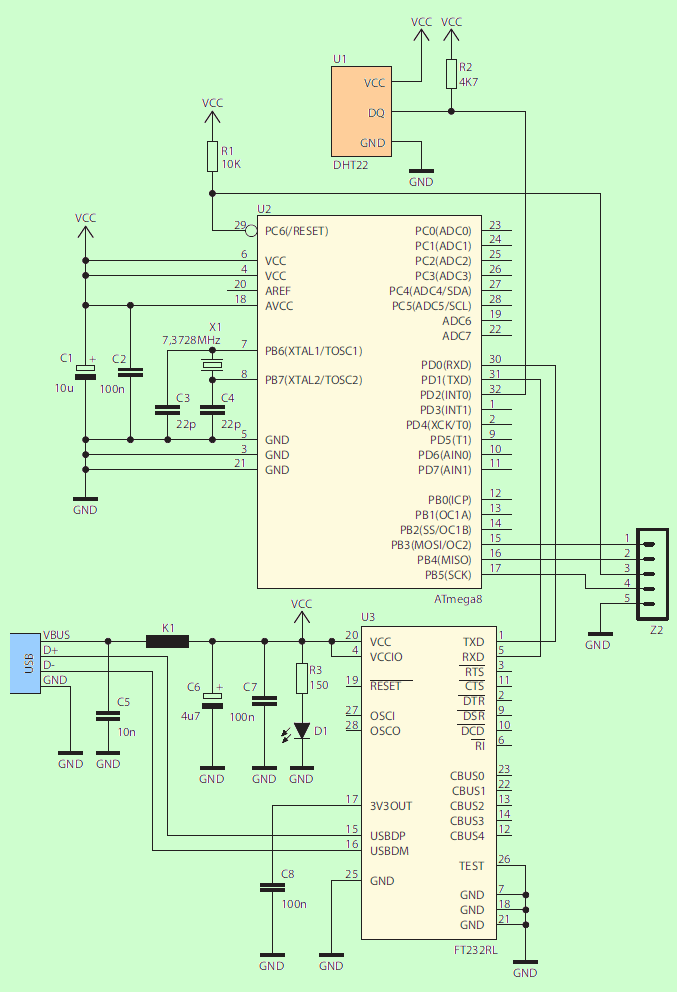
The schematic diagram of the thermometer Its “heart” is the ATmega8 microcontroller operating with an external 7.3728 MHz quartz resonator. The clock frequency was chosen so that the transmission error of the UART system was 0%.
The project uses the ATmega8 microcontroller in the smd TQFP32 housing and the FT232 chip in the SSOP28 enclosure, which, due to the raster patches, needs to be mounted on the rack. After soldering the microcontroller and the FT232 system, solder all jumper and serial components in order from smallest to largest.
Source: THERMOMETER HYGROMETER CIRCUIT USB DHT22 ATMEGA8
- What is the temperature measurement range of this device?
The device measures temperature from -40 to 80 ° C. - How accurate is the temperature reading?
The accuracy of the temperature measurement is 0.2 ° C. - Can this device measure humidity levels?
Yes, it measures humidity from 0 to 100% with an accuracy of 2%. - What microcontroller is used in this project?
The project uses the ATmega8 microcontroller operating with an external 7.3728 MHz quartz resonator. - Why was the 7.3728 MHz frequency chosen?
The clock frequency was chosen so that the transmission error of the UART system was 0%. - In which software environment was the control program written?
The microcontroller control program was written in the Bascom AVR environment. - What type of housing does the ATmega8 use in this design?
The project uses the ATmega8 microcontroller in the smd TQFP32 housing. - What enclosure is used for the FT232 chip?
The FT232 chip is used in the SSOP28 enclosure. - Is this device suitable for use with a laptop?
Yes, due to its tiny size and surface mount elements, it can be used as a laptop or desktop adapter. - What is the recommended soldering order for the components?
You should solder all jumper and serial components in order from smallest to largest after mounting the main chips.
