AVR ATmega Projects

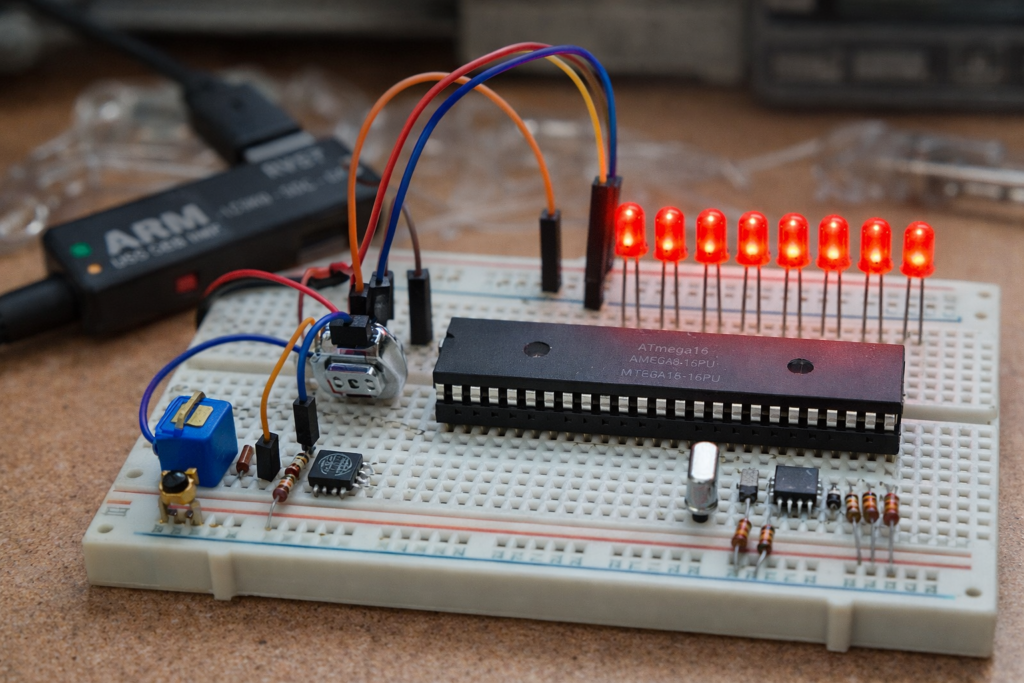
ATmega16 breadboard ADC LED display

AVR ADC using ATmega16 with TLC549 Serial ADC in Proteus Simulation

Introduction AVR ADC using TLC549 demonstrates how analog signals from sensors can be converted and processed by a microcontroller. Analog signals from sensors cannot be processed directly by most microcontrollers because they operate using digital logic. To bridge this gap, Analog-to-Digital Converters (ADC) are used in many microcontroller projects and embedded systems. This project demonstrates […]

AVR ADC using ATmega16 with TLC549 Serial ADC in Proteus Simulation Read More »
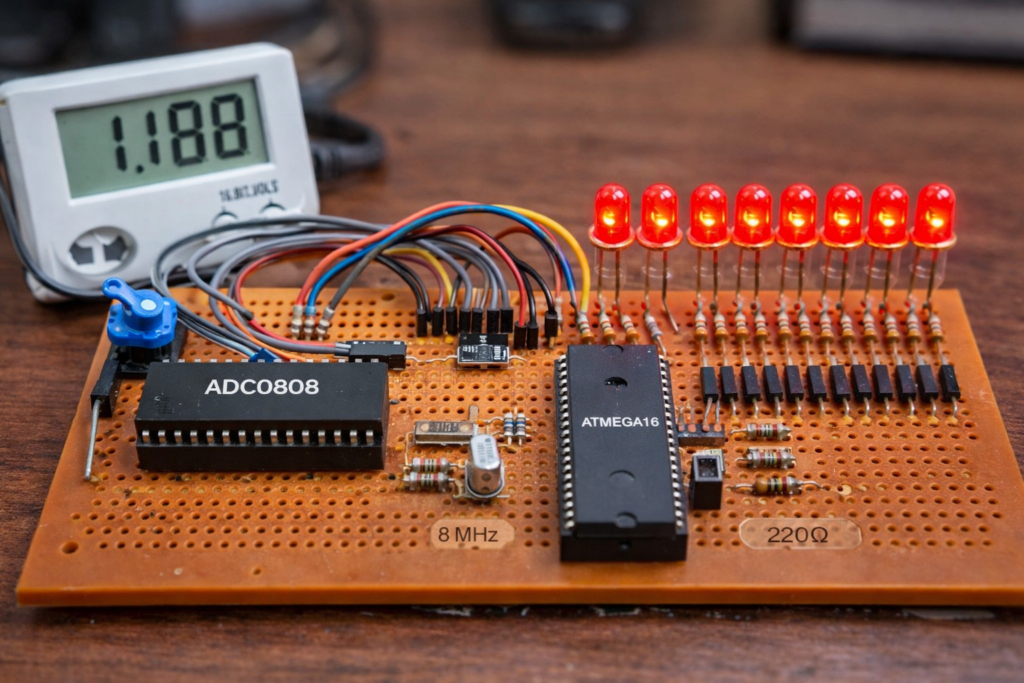
ATmega16 ADC0808 LED display electronics project

8-bit ADC with ADC0808 using ATmega16 with Proteus Simulation

Introduction Analog signals are everywhere in real-world electronics, but microcontrollers process digital data. In this microcontroller project, an ADC0808 analog-to-digital converter is used with the ATmega16 microcontroller to convert an analog voltage into an 8-bit digital value. The converted digital value is then displayed through LEDs, making it easy to visualize the analog input level.

8-bit ADC with ADC0808 using ATmega16 with Proteus Simulation Read More »

Dual thermometer prototype with LCD display

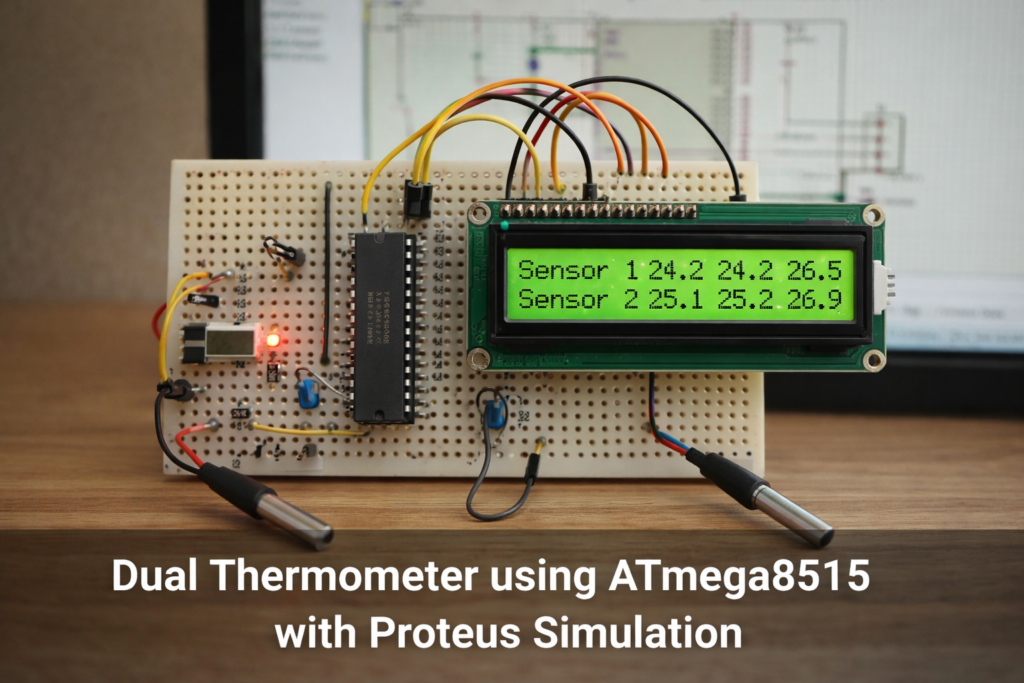
Dual Thermometer using ATmega8515 with Proteus Simulation

Introduction This microcontroller project shows how to build a dual digital thermometer using an ATmega8515 and two DS18B20 temperature sensors in Proteus simulation. The system reads temperature from both sensors, displays the live values on a 16×2 LCD, and also keeps track of minimum and maximum readings. It is a practical example of embedded systems

Dual Thermometer using ATmega8515 with Proteus Simulation Read More »

AVR memory access breadboard setup

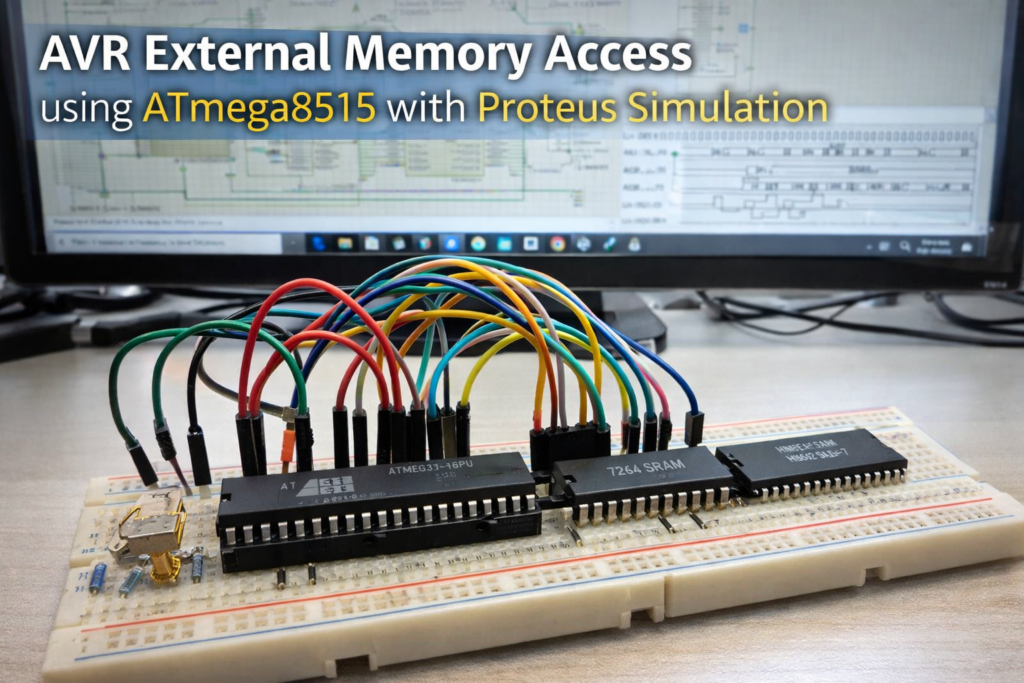
AVR External Memory Access using ATmega8515 with Proteus Simulation

Introduction This microcontroller project demonstrates how an ATmega8515 communicates with external memory inside a Proteus simulation environment. The design focuses on memory access cycles, showing how the AVR handles external address and data lines when connected to SRAM. It is a useful example for anyone learning embedded systems, memory-mapped interfacing, and practical electronics. Instead of

AVR External Memory Access using ATmega8515 with Proteus Simulation Read More »

Wireless Locker Control Unit with ATmega328 and Secure Authentication

System Level Design System Requirements Delineates the core functionalities required for the project, which is to establish a secure and user-friendly locker access system. The fundamental purpose is to provide controlled access to lockers for students and robust management capabilities for administrators. Its applications include a Wireless Locker Control Unit. Reading student ISU ID cards

Wireless Locker Control Unit with ATmega328 and Secure Authentication Read More »

Pacemaker Challenge on AVR/Butterfly Boards

The design and development of safety-critical embedded systems demand a rigorous methodology that ensures reliability, timing accuracy, and correct functionality under all conditions. This article presents an in-depth commentary and technical walkthrough of a model-based development framework centered around the use of AVR/Butterfly boards, heart simulators, and pacemaker controller systems. We explore the theoretical modeling,

Pacemaker Challenge on AVR/Butterfly Boards Read More »

ATMega Control Board Manual V1.0 – Complete Setup and Guide

ATMega Control Board Manual V1.0 – Complete Setup and Guide

The  ATMega Control Board Manual describes an advanced microcontroller-based platform designed to facilitate high-speed, real-time and deterministic embedded processing in a resource-limited environment. The Atmel ATMega32 microcontroller, the primary processing unit, is based on an 8-bit Harvard RISC architecture with a maximum processing frequency of 16 MHz, giving a peak throughput of 16 MIPS. This supports

ATMega Control Board Manual V1.0 – Complete Setup and Guide Read More »

Wireless RGB LED Control with Android and Bluetooth

Over the past decade, microcontrollers have gained significant popularity across various fields, including consumer products and industrial applications. At the same, smartphones have transformed the type of personal computing and provided Internet connection to billions of individuals globally. As expected both of these technologies have merged with the result of mobile devices. Can command and

Wireless RGB LED Control with Android and Bluetooth Read More »

The ATmega1280 An Advanced 8-Bit Microcontroller

The ATmega1280: An Advanced 8-Bit Microcontroller

Introduction The ATmega1280 is an 8-bit microcontroller developed by Microchip Technology very efficiently. Being one of the most complex models in the ATmega series, it provides a good basis for making various embedded systems. So, in this discussion, I will feature its main characteristics and technical specifications and also present some case studies of its

The ATmega1280: An Advanced 8-Bit Microcontroller Read More »

Scroll to Top