Sensor – Transducer – Detector Projects

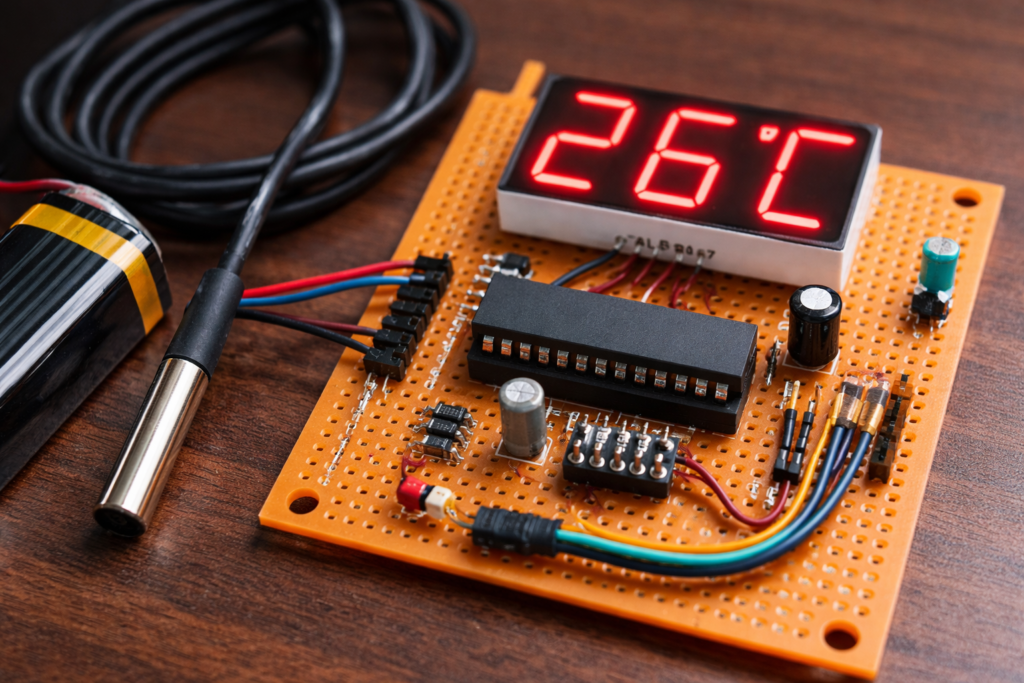
ATmega16 DS18B20 temperature display prototype setup

Temperature Meter using ATmega16 with Proteus Simulation

Introduction This microcontroller project demonstrates a digital temperature measurement system using the DS18B20 sensor and an ATmega16 microcontroller. The system reads temperature data and displays it on a dual 7-segment display in real time. Built and tested in a Proteus simulation environment, this project is a great example of embedded systems and practical electronics. It […]

Temperature Meter using ATmega16 with Proteus Simulation Read More »
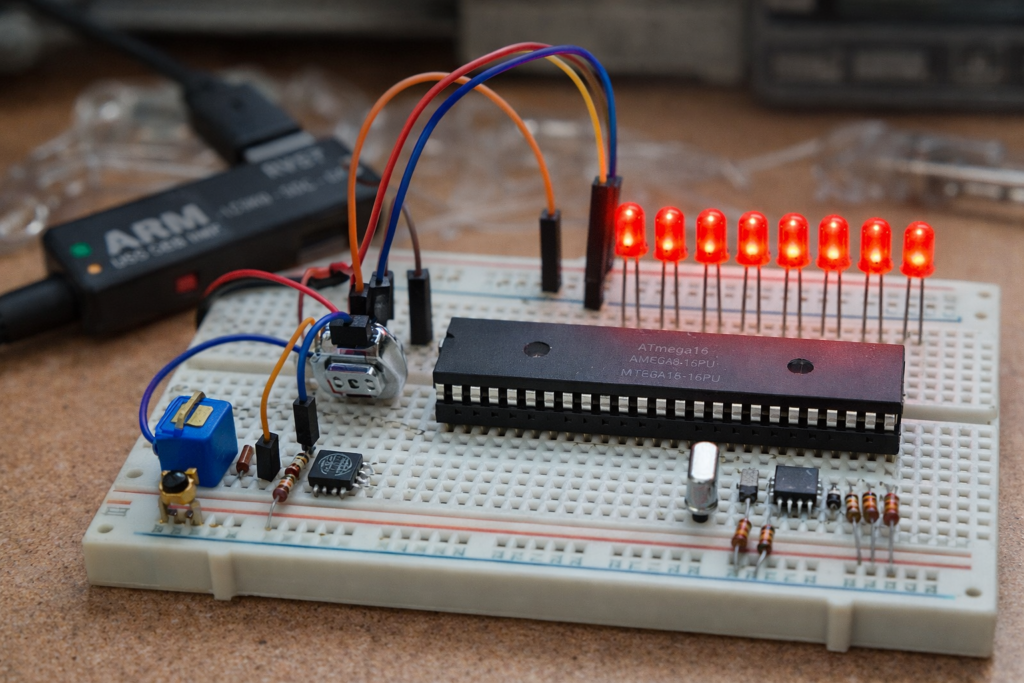
ATmega16 breadboard ADC LED display

AVR ADC using ATmega16 with TLC549 Serial ADC in Proteus Simulation

Introduction AVR ADC using TLC549 demonstrates how analog signals from sensors can be converted and processed by a microcontroller. Analog signals from sensors cannot be processed directly by most microcontrollers because they operate using digital logic. To bridge this gap, Analog-to-Digital Converters (ADC) are used in many microcontroller projects and embedded systems. This project demonstrates

AVR ADC using ATmega16 with TLC549 Serial ADC in Proteus Simulation Read More »

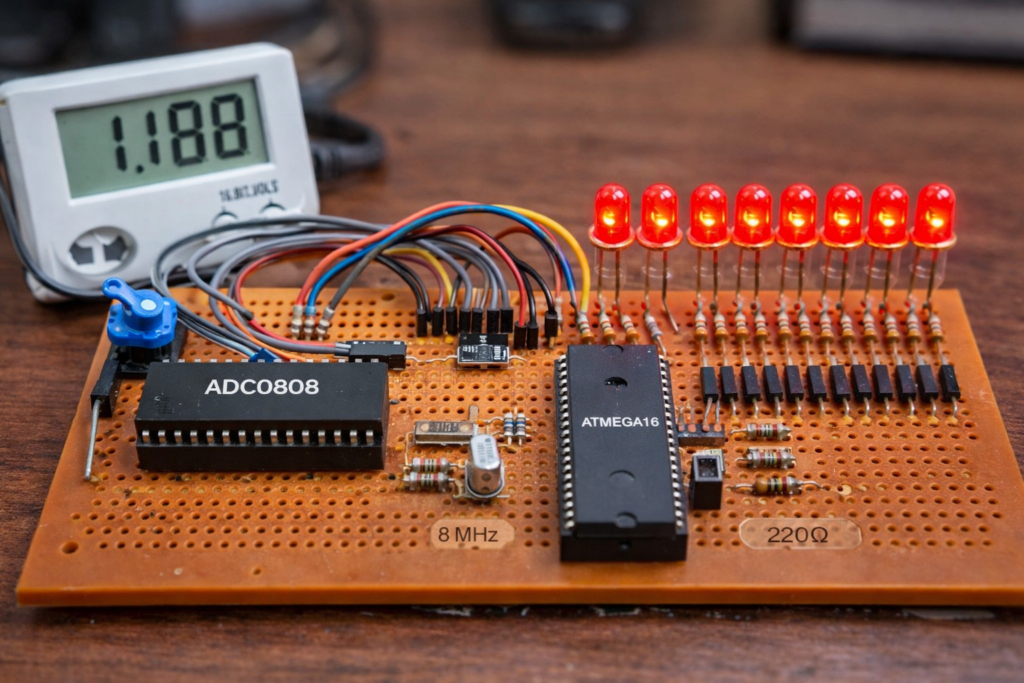
ATmega16 ADC0808 LED display electronics project

8-bit ADC with ADC0808 using ATmega16 with Proteus Simulation

Introduction Analog signals are everywhere in real-world electronics, but microcontrollers process digital data. In this microcontroller project, an ADC0808 analog-to-digital converter is used with the ATmega16 microcontroller to convert an analog voltage into an 8-bit digital value. The converted digital value is then displayed through LEDs, making it easy to visualize the analog input level.

8-bit ADC with ADC0808 using ATmega16 with Proteus Simulation Read More »
Dual thermometer prototype with LCD display

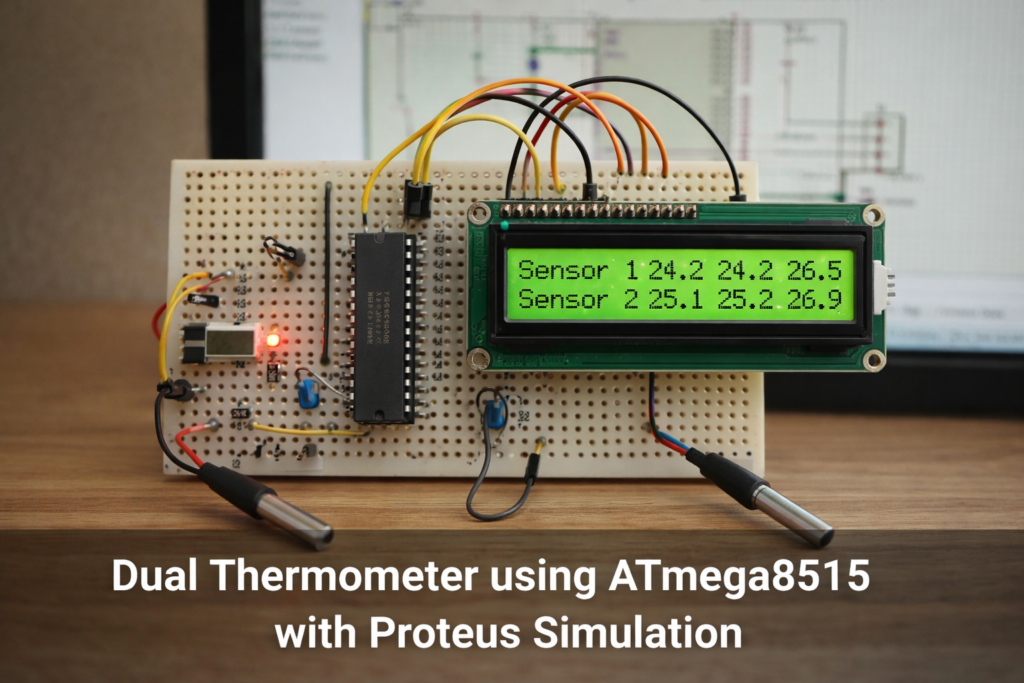
Dual Thermometer using ATmega8515 with Proteus Simulation

Introduction This microcontroller project shows how to build a dual digital thermometer using an ATmega8515 and two DS18B20 temperature sensors in Proteus simulation. The system reads temperature from both sensors, displays the live values on a 16×2 LCD, and also keeps track of minimum and maximum readings. It is a practical example of embedded systems

Dual Thermometer using ATmega8515 with Proteus Simulation Read More »
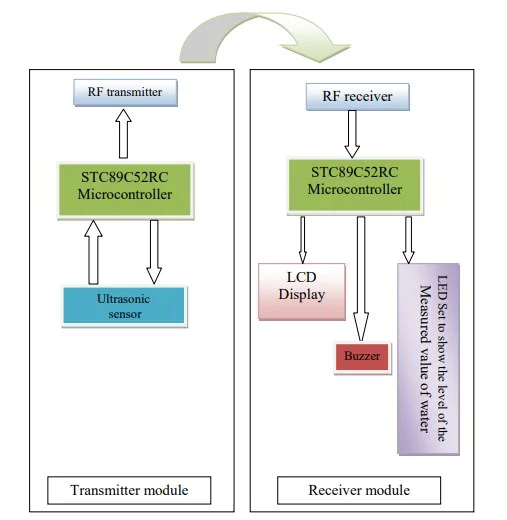
Building a Real Time Wireless Flood Monitoring System with HC SR04 and AVR ATmega 1

Building a Real-Time Wireless Flood Monitoring System with HC-SR04 and AVR ATmega

Objectives There are a few objectives that need to be met to get this project done: These objectives will act as a guide and restrict the system to be implemented for certain situations: To develop a model of REAL TIME WIRELESS FLOOD MONITORING SYSTEM by using the ultrasonic sensor to measure the water depth in

Building a Real-Time Wireless Flood Monitoring System with HC-SR04 and AVR ATmega Read More »

MasterUnitCircuit

Smart Fire Detection: A Wireless Sensor Network Approach for Indoor Arenas

Abstract This document details the development and implementation of a wireless fire alarm system, managed by an ATMEGA32 microcontroller, featuring Master and Slave Unit Controllers. The system receives input signals from normally opened warning devices like heat detectors and/or smoke detectors, with the unit containing these detectors referred to as the slave unit controller. The

Smart Fire Detection: A Wireless Sensor Network Approach for Indoor Arenas Read More »

How to Use Hall Sensor with AVR Microcontroller ATmega16

How to Use Hall Sensor with AVR Microcontroller ATmega16

Hall sensors works on the principle of Hall Effect proposed by Edwin Hall in 1869. The statement proposed says, “The Hall effect is the production of a voltage difference (the Hall voltage) across an electrical conductor, transverse to an electric current in the conductor and to an applied magnetic field perpendicular to the current.” So, what could

How to Use Hall Sensor with AVR Microcontroller ATmega16 Read More »

Scroll to Top